Tag Archives: healthy-living

Taking time out

When was the last time you actually did nothing ? Not reading, working, gardening, sleeping, cooking etc just literally sat down and did no thing which is what doing nothing is all about.

Our bodies and minds need time out from the frantic pace of life and yet there is often a guilty feeling associated with just sitting down doing nothing. I know there are many things that we do for relaxation such as reading, arts etc but this still requires us to to engage with some action whereas doing nothing asks no more that to be. Be present with your body as it is and the breath. It can be challenging. We fidget, notice the mind swirling with thoughts and start planning our next activity etc but it is worth persevering with the practice and noticing the discomfort that arises. After a while the process becomes easier and you will find yourself feeling a lot more rested and refreshed than if you had been relaxing with a book or watching an interesting show.

The first step is in stilling the body and allowing yourself to be exactly where you are. Noticing where you are and how you are sitting. The next step is to become aware of your breathing. Examining the depth, speed, temperature etc of your natural breath. Then you can employ either a count of the breath or a simple mantra to keep the mind from wandering as you watch your breath. You only need to practice for short time 5 or 10 mins. Try practising this a few times a week and see how it works for you. I would be interested in your feedback.

Here is a little guided session to get you started.

Om Shanti

At this time of year all you need is presence not presents!

Another year has flown by and we may find ourselves caught up in the rush to get things done or ready. Often we can place enormous pressure on ourselves and others without realising it until we collapse sometime Christmas afternoon! 

Yoga is a reminder that even though things seem to be speeding up we can slow down. It is OK to take time out, to say no thanks and just spend time with the breath. Even a few minutes each day of sitting quietly and watching where you feel the breath, focusing in the movement of the body with the breath can make a great deal of difference with how we manage what is often referred to as the “silly season”.

I guess it gets this name because we can go a little “silly” trying to keep up with our own or others expectations but life is not really about keeping up it is about being present. If we are so busy rushing to get to everything, buy everything, see everyone, finish everything in those last few weeks of the year all we will remember is the rushing. We will miss the little pockets of joy that make Christmas special.

Take a moment to imagine yourself a child again and see it through the eyes of that child. The wonder of the warm summer evenings, the smell of a Christmas tree, the twinkling of Christmas lights, the taste of a few special treats, the closeness of friends and family. Forget about buying presents and offer your presence to others and be with the people you know and perhaps strangers in need of kindness. Be kind to yourself and take those few moments to be fully in your body and sit with your breath . Maybe even do a regular yoga nidra.

wishing you all a safe and restful festive season

Here is a little present presence for you Om Shanti

When a bad back is holding you back.

I hope you have all enjoyed a restful winter break and like me are feeling the stirrings of spring and a desire to get out in the garden! (at least for those of us in the southern hemisphere) Yoga can be so helpful in managing those sore backs that come from too much enthusiasm with the weeding and mulching! For some though, these problems are not just the result of enthusiastic gardening but much more chronic.

I have often heard people say “oh I can’t go to yoga because I have a bad back” and believe me I know what people mean when they say that they have a “bad back”. I have had back problems myself for the last 18 years which have been the result of disease processes. However far from this deterring me from practising yoga, I have found yoga to be a boon for helping me to cope with pain, improve flexibility, core strength and generally improve both my mood and the discomfort that structural damage to the back can cause.

The reason I think people are reluctant is that we get into “protective mode” where we fear that practising yoga may make things worse. I was lucky enough to have been practising yoga before my back injuries so I was keen to try to recover some of that once the acute phase of my injuries was over. This is the key really. If you are in the acute phase of any injury then the best course of action is rest and pain management but as soon as you feel you are able, a little bit of supported and gradual exercise will help to loosen the tight muscles around the damaged area, improve blood flow and generally make you feel better.

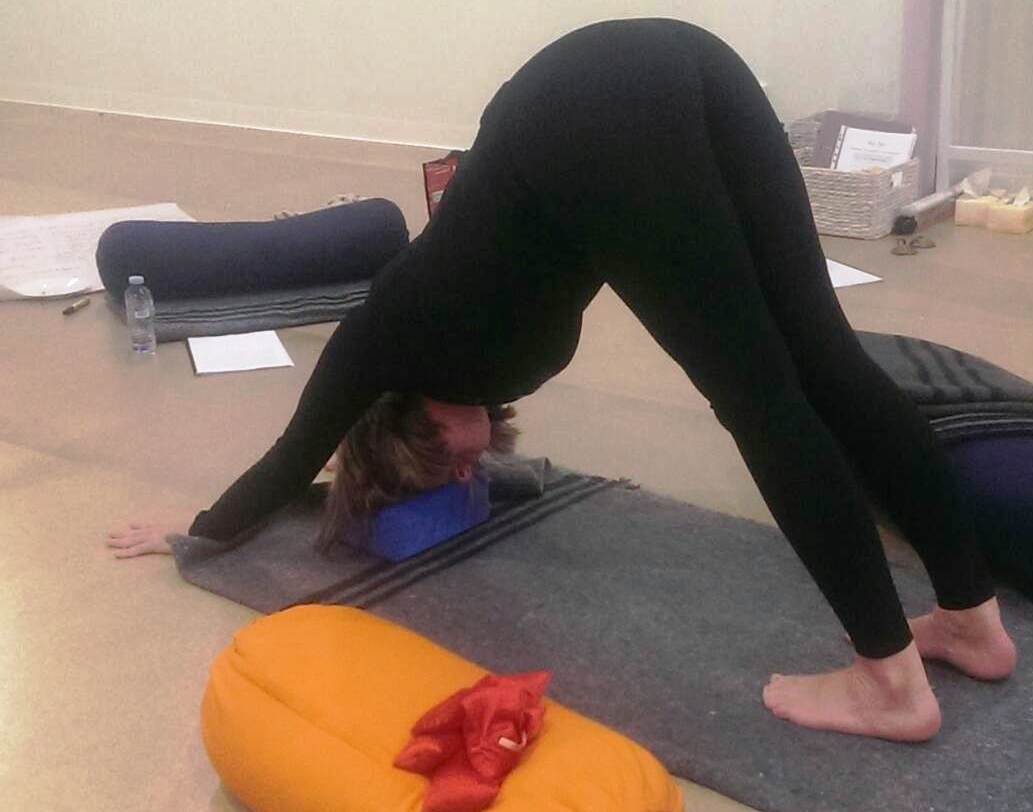
I run a class especially for people with lower back problems. Much of the class is floor work and concentrates on supporting the lower back by building core muscle strength. There are many modifications for most if not all the yoga postures and using supports like blocks, straps, folded blankets you can usually find a way to get the body comfortable in the chosen pose. There will be poses though that are not suitable or perhaps no longer suitable for your body and that is quite OK.

Remember yoga is not about the shape of your body but the shape of your life! Pain and feelings of inadequacy because you can no longer do certain things takes its toll on your sense of well being , your mental health, your relationships with others and this again is where yoga can help. The relaxation, meditation and breathing practices can be done in many different positions with as much support as you need to be comfortable. These practices will help you to deal with the stress of your changed circumstances and provide deep rest for your body and mind.

Of course you need to look carefully at the type of yoga class you are considering and seek the advice of your doctor or physiotherapist to help determine your readiness before starting. Make sure your yoga teacher understands your health issues and any anxiety you have around that. A good yoga teacher will listen and tune in to your needs. When practising poses let go of the desire for perfection and competition. It is more about where you are at and listening to your body. Learn to recognise the difference between the discomfort of stretching and any pain that is your body saying “no this is not right for me”. There is a real difference between compression ( this bone is hitting that bone ) and tension ( this muscle or ligament is tight)* See previous post March 2013

You may even want to experience a one on one class with your teacher first to make things easier for know where you are at before joining a group. So if you have been holding back because of your back perhaps it is time to give it a go!

International Yoga Day 2023

June 21st marks International Yoga Day for this year coinciding as per usual with the winter solstice for those of us in the southern hemisphere and the summer one for those of you in the northern hemisphere.

The theme for this year is Vasudhaiva Kutumbakum. It is a Sanskrit phrase found in Hindu texts such as the Maha Upanishad which means “The World is One Family”. Vedic tradition mentions ” Vasudhaiva Kutumbakum” meaning all living beings on the earth are family. Now that might be something worth celebrating and acknowledging in a world that often seems so troubled!

I hope you can find something in your local area to participate in as part of this celebration. Here in Beechworth we will be having a free community relaxation session with the very special practice of Yoga Nidra for all who wish to try it. If you live nearby why not come along to the the Quercus Neighbourhood centre Weds evening at 5.30pm for half an hour ? Bring something warm to snuggle under and your yoga mat and perhaps bring a friend! For more information please email .

Time for change

Have you been feeling a little tired lately ? The change of seasons can often affect us in very subtle and sometimes not so subtle ways. Sometimes it is hard to adjust and the body and mind need a little catch up time to get there.

Here is Australia the evenings are cooler as are the early mornings but we can still have some quite hot days. I gather that in the northern hemisphere it is still quite cold in many places and you are longing for the warmth of spring sunshine. Once again I am looking into my yoga toolbox to help me adjust and you might like to as well.

For those of us “down under” getting into some more dynamic practices like Salute to the Sun will help to get you going in the cooler mornings and if this is not something that you are ready to practice you could try practices like Nauka Sanchalanasana or rowing the boat, Utthanasana (squatting and rising ) to get the heart rate up and the prana moving. These would also be useful for cooler mornings up north until the sun is really warming you up.

Cleansing practices like Neti , Kapalbhati, and Lagoo Shankaprakshalana are also suggested by the yogis to help the body cleanse and prepare for the changing seasons. The first practice is a nasal washing practice good for cleansing pollens of springtime or indeed clearing the mucus that can develop with the onset of viruses as you move into cooler weather. The second practice is a breath practice to clear the mind and the third one is used to clear the digestive tract. All of these practices should be taught by a trained yoga teacher before you really attempt them on your own.

Eating according to the season is also something recommended so moving away from the heavier winter foods in the north to lighter meals whilst those in the southern hemisphere may be drawn to more easily digested soups and dhal, away from the many salads and lighter food we have been eating.

Last but certainly not least would be incorporating a regular yoga nidra practice (for more on yoga nidra see blog post Yoga Nidra) into your day. Disturbed sleep can leave you tired and cranky but a 15 min yoga nidra will leave you refreshed and completely relaxed. If you haven’t tried it yet then please give this little offering a go.

getting started again

What an apt post for me when it has been ages since I have I have been active on my yoga blog.  What is it that makes it so hard to restart something when you have been away from it for whatever reason?  Many of you will have experienced a break in your yoga practice for a period of time and it can be very hard to kick-start the healthy habit of spending time on your mat.

spring garden 006Spring is such a great time for new beginnings though and it is worth reflecting on just what has happened over the winter season.  That period of dormancy or quiet time has provided the opportunity for a much needed rest for nature and perhaps yourself.   With the rising soil temperatures and warmth of the sun there is increasing vitality and energy resulting in all sorts of growth and the need to be pare back the dead wood which in itself is a good thing.   If you spend some time outdoors you can feel the promise of spring ..an opportunity for movement forward.

In the same way look at your own life ..what needs to be pared back?  Ask yourself “am I aware of increasing vitality of spring?  Is there anything I can do to embrace this period of growth to enhance my  life?”  If your yoga practice has slipped do not be afraid to roll out the mat again…be kind and gentle with yourself.  Start slowly and build up using practices like gentle back bends – those wonderful extroverting poses, include a few rounds of salute to the sun, take your shoes off and free up your feet, start your day with mantra chanting or join a new class.

The Koshas

The-Koshas_background-1030x1030[1]

What is the yogic approach to physiology?  The ancient yogis believed that the individual was made up of 5 layers or sheaths of experience and these were called the koshas.   These koshas explain our relationship and experience with the environment, the breath, the mind and higher levels of consciousness.  They provide a way for us to find our way into the subtler layers of our being.

The first layer or kosha which we are most likely to be aware of is one called annamaya kosha  or the body sheath.  It occupies about 75% of our awareness.  This is our relationship with the body, the bones, muscles, ligaments, organs  and how we interact in our environment through the senses of sight, touch, taste, smell and feel.   It concerns the foods we eat, the things we do, our sleeping habits, the media we expose ourselves to, the people in our lives and places we visit.   You may notice that some people or places make you feel content, happy and positive whereas others make you feel anxious, exhausted, fearful.  Similarly you may find that when you get regular sleep and take regular meal breaks with healthy food choices you generally feel better.  The same goes for exercise be it yoga or some other form of physical activity.

Once we become conscious of these things we are able to use yoga to create a steady experience of annamaya kosha.   Some things to consider may be setting a regular time for going to bed,  making changes to our eating habits in terms of what you eat and when( you could even use Ayurvedic principles here).  Making conscious choices about the people we spend time with, not just putting up with it.   Establishing a regular yoga practice and taking time for stillness in meditation.   Creating balance in annamaya Kosha creates a ripple effect to the higher koshas or layers affecting energy levels and or mental balance.

Yoga practices for harmonising the physical body include:

  • asana by toning and strengthening the body,
  •  pranayama (breathing practices)  by increasing breath capacity, physical energy and balancing the cerebral hemispheres
  • meditation and yoga nidra to provide stress relief and balance the fight/flight response
  • cleansing practices like neti, kunjal  to keep mucus membranes and tracts lubricated and healthy

Some of the principles in the management of Annamaya kosha include:

  • regularity of sleep, meals, yoga practice
  • simplicity of food, daily routine
  • moderation – not overdoing any addictive behaviours
  • discipline – not rigid or suppressed but in developing the ability to control the mind
  • awareness i.e.. consciously listening to the body’s needs
  • tapas or sacrifice ..opportunity for fasting
  • cleanliness
  • flexibility
  • adaptability


Restoring the soul

july august 2011 034

I have just commenced teaching my first fully restorative yoga class having completed Level 1 training in restorative yoga teaching last year.   Since this course I have introduced a few restorative poses into my mainstream classes to stimulate interest and invested in some bolsters with a view to running a group that was dedicated to restorative yoga.


So what is restorative yoga and why do we need it?  A restorative yoga class typically has only 5-6 poses which are held for longer periods of time using the support of props such as bolsters, blankets, blocks and even straps.   These poses are designed for you to move more deeply into the stretches while your body softens and rests on  the supports.     They include, forward bends, backbends, twists, lateral stretches and passive inversions and many are based on the teachings of BKS Iyengar.  As you are holding poses for longer there is greater capacity to tune into the breath, to explore the effects of breath on the physical body and the mind.

Some of the benefits of restorative yoga include, soothing the nervous system, encouraging mindfulness, cultivating heightened body awareness, creating a sense of acceptance and detachment and feeling safe and nurtured.

At the time when I was looking for a restorative practice myself I was grieving the death of my beloved mum.  I felt that I just wanted to be held in a warm and comforting space where my body could release the tensions both physical and mental that had built up during that time.  It was about letting go of doing anything in particular and just experiencing the present moment in a safe and comfortable environment.

According to Liz Koch international teacher and author “We need more capacity to endure pleasure…we only do something to get out of pain.  We don’t do something because it brings us pleasure; a sense of calm and nourishment.  We don’t know how to nourish ourselves with movement as well as food…we need to learn to take care of ourselves and to explore this concept of nourishment.”

Restorative yoga is about that exploration.  It is about taking more time to feel into poses,  to allow for rest, rejuvenation and not trying to “fix things”.  It is about surrender… whether it is to your day, your life, your pain, your grief (as it was and still is on many days in my case), your happiness or joy, and loving and respecting your body.  So of course what better time to start a restorative class than in winter when we look for comfort and restoration?


IMG_20160828_181619


Learning to let go

Autumn is such a lovely time of the year.  I always marvel at the beautiful display that nature puts on before she decides to have a rest over the winter and watching autumn leaves fall is such a peaceful pastime. Recently I was thinking about how clever nature is to cast off that which is no longer needed  and was reminded of the value in doing just that ourselves!

autumn2 022

How often do we get stuck repeating the same old patterns and habits that we know do not really serve us anymore? These old patterns or conditionings are known as samskaras to the yogis.  They are based on past experiences and if left continue to influence the way we function in this world.  Perhaps you find yourself always apologising for your behaviour?  Putting others needs before your own? Not taking time out for yourself,  feeling that you somehow do not measure up or need to work harder, faster, to feel good about yourself??

There may be some things that really push your buttons; people who don’t appreciate you,  people who think differently or treat you in a particular way.   At some stage we all need to ask “is my behaviour and response helping me to grow?”  If this is not the case then perhaps it is time to let some of this stuff go.  Just like the deciduous trees around us it can be healthy and a great relief to just drop it!!

How can yoga help us to do that?

To begin with true yoga requires you to be fully present.  This is something that develops with time and practice.  You make a conscious effort to keep the mind with the practices by following the breath, counting rounds and focusing on different parts of the body as you move into postures or asanas as they are called.

By becoming fully present you begin to notice the mind and how quickly it jumps from one thing to another …how easy it is to be distracted by thoughts.  Some of these thoughts are quite repetitive and they generally have no basis in truth but are based on some past experience where you felt a certain way or reacted to something.  To watch without getting caught up is the secret because this allows us to detach from all the emotional baggage around the thought.

By using particular breathing practices you can balance the breath and learn to control our breathing when we are anxious and stressed by events around us or things that people say.  This creates the space necessary for you to take that step back to “see” your usual reaction or response and decide consciously if this is what you want to say or do.

The practice of yoga nidra (see post from Jan 2012) allows the time and space for physical rest but also offers the opportunity for the samskaras to become apparent and be released.  Particularly when the teacher is using opposites and visualisations as these may invoke feelings and memories that you learn to watch in a relaxed and detached state and they begin to lose their power in your waking state. In yoga nidra you set an intention for your life.   A short positive statement about something you are working toward (a sankalpa) when you are in the deeply relaxed state that yoga nidra brings about  can guide your actions and thoughts in your waking state.

Letting go is not instantaneous  but the benefits of practising the art of “just dropping it” are so worthwhile.  You are no longer reacting to things but choosing how you wish to respond.  It does not matter how many times you need to practise..it is the fact that you do which will make the difference.  So take some inspiration from the deciduous trees and stock up your yoga toolbox..it will change your life.


Building a foundation

DSC_0125As we move into the season of Autumn it could be a great opportunity to look at what is truly important in your life. It can be a busy time over the summer with friends, relatives, holidays, work and getting children back to school.  It is at times like this when our yoga practice can suffer as we get caught up in all the “doing” of life, but one thing is for sure if you have built a  strong foundation in your yoga practice then it will support you as you navigate your way around the “busy-ness” of life.

How do you build a strong foundation?  One of  the most important features of yoga is its ability to keep you grounded.  When all around you seems to be flying off in many directions…taking  time to be still and focusing on the breath is the perfect way to ground yourself.  The many pranayama or breathing techniques taught in yoga provide tools to help (literally)  keep your cool ( try Sheetali or Sheetkari breathing) and focused on the here and now.

Asana practice too will provide you the opportunity to be in your body…. to feel the parts that feel good, the parts that need more TLC, the parts you worry are not quite right and the parts you love (yes loving your body is part of a solid foundation!!).  As you move through a small sequence of postures listen to the messages from your physical body, not the chatter in your head and allow your body to move with the breath.  No matter what state you are in when you move to your yoga mat it is as if all the other stuff dissolves  (sometimes it takes a little longer but it will happen) …

Developing your own meditation practice is also the basis of a strong foundation in yoga.  There are many different meditation techniques and it is worth exploring different ones to find what suits you.  If you find sitting still difficult try a walking meditation.  You don’t have to meditate for very long for meditation to be effective.  Again it is the practice of often being present …of allowing yourself to simply be.  Some people find the regular activity of simply lighting a candle and some incense or exploring nature as way to stop the clock for a brief moment.

All of these practices contribute to what we call a sadhana.  A sadhana  is a regular spiritual practice that helps you to find balance in your life by giving you the opportunity to turn inward.  It is not a religious “thing” ( you may or may not have a connection to some higher God and you could incorporate this)  but it is an attempt to connect with the bigger picture…nature, your place on this earth, the bigger YOU.

Having a sadhana means you are making a commitment to yourself.  It requires discipline (even if it only 10 mins a day) so cultivates this.  It allows you to grow as a person affecting your relationship with yourself and others. A sadhana  provides an opportunity for self reflection…to look at the patterning of the mind, to see your thoughts as they come and go…to discover that your thoughts are not you.  And of course it builds a foundation…just like your sankalpa ( see post from Jan 2012) .  A strong platform from which you can make decisions about your life, your work, your health, your relationships with others.  This foundation is strengthened by the repetition and regularity with which your sadhana is performed.  No matter how small you start, by developing this regular practice you will slowly notice a shift in the constant demands of the mind…you will not feel so swayed by the fluctuations of mind and emotions and find yourself more accepting of yourself and life ups and downs.

So how do you go about this?  First of all find a space that you feel comfortable in – a part of your room,  a separate room, somewhere outside.  Decide how long you wish to practice each day and what your sadhana components will be.  Remember this can be as small as lighting a candle and sitting quietly for a few moments.  It may include asana practice, breathing practices, chanting, singing, meditation, walking in nature…choose what you know makes you feel good.  It does not have to be a long session…it is the regularity that provides the benefit not the length of practice.

I find practising my sadhana first thing in the morning the best for me..it allows me not to get caught up in the day and make excuses for missing it and I always find mornings more peaceful (mind you I am well past the age of having little ones awake before me and making their own special demands on my time!!) so if mornings don’t suit find a time that does and make it your time.

May you find time to be you.