Tag Archives: yoga practice

Autumn musings

The colours are looking beautiful here in Beechworth at the moment as we head into term 2 of yoga classes. I think of this term as a time of settling in to the cooler mornings, the evenings getting darker and preparing us for the winter months ahead. It is a time of reflection and also a time to rest after the heat and busyness of the warmer weather and long evenings.

Yoga is often more about the rest between practices and poses than the poses themselves. It gives us time to observe any changes in the physical body, our thoughts and/or our emotions. There is the chance to deepen your awareness of the effects of practices.

We all come to yoga to stretch, to relieve tension, to relax and perhaps heal in some ways both on a physical and emotional level so these rest times are a very important part of the process. It is not simply a matter of banging through a number of poses, a few breathing exercises and a relaxation practice. It is about developing that inner awareness of what each practice can reveal.

Often the reveal might simply be “gee my right shoulder has been really tight lately” or it may be something along the lines of “every time I focus on my breathing I feel a lot calmer” or even something deeper like “those hip opening postures made me want to cry today”. Each time we can pause to reflect or allow the practice to do its work we discover a little more about our bodies and ourselves. As we know yoga is not just about the shape and state of your body but also about the shape and state of your life.

We often hold a lot of tension in the hips and hip opening poses like pigeon pose or gecko pose help to release that tension. Similarly shoulder opening through shoulder circles, threading the needle and the double angle pose can release the tightness that comes from feeling you are carrying a load on your shoulders.

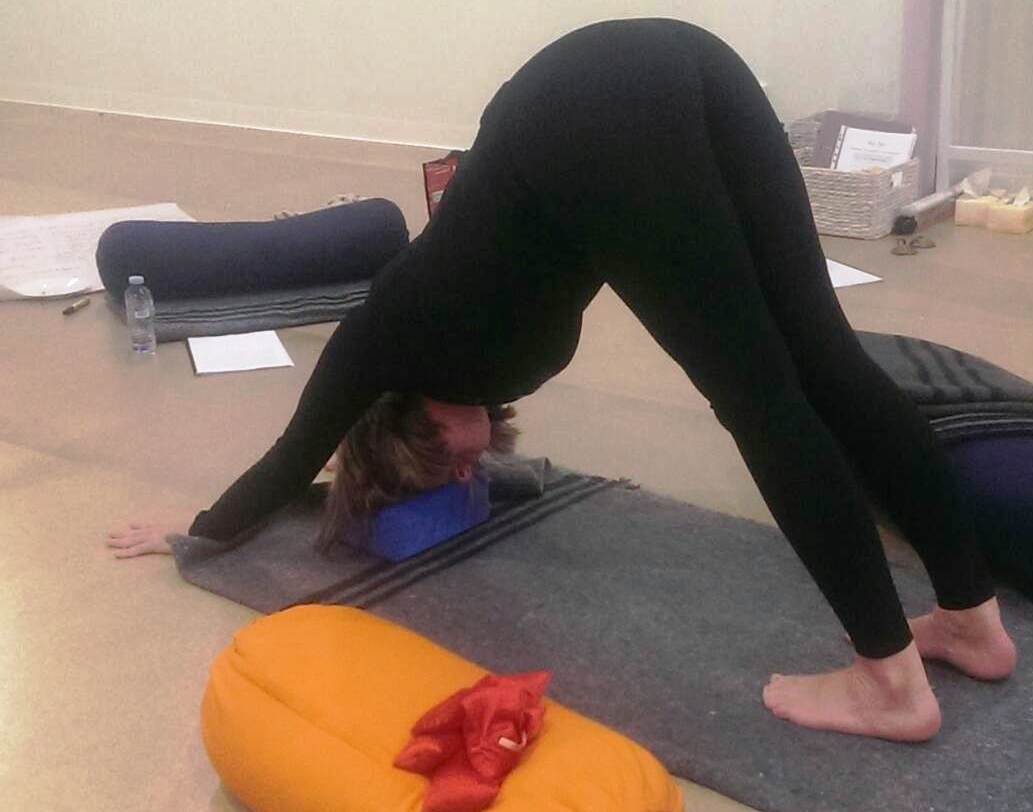
I love those little pauses in shashankasana (pose of the child), parvartasana ( mountain pose or you may know this as downward dog) and simply resting in shavasana (corpse pose) and I hope you can enjoy them too. Perhaps this is really the slow yoga ..the tasting bits and noticing what is happening. I always like to finish my classes with the students pausing for a brief moment to reflect on any changes in how they are feeling physically mentally and emotionally. Not in a judgmental way but in a curious way.

Let me know what you think about those pauses and what you notice after your yoga class. I look forward to seeing some of you on the mat next week.

Shakti

In the same way there are specific asanas that help to boost the digestive fire and release blocked energy within the body. Some of these practices are known as the Shakti Bandha practices , where bandha is seen as a lock or block that can be moved . An excellent example of this is the wood chop pose or Kashtha Takshanasana . Other practices include Nauka Sanchalanasana or rowing the boat, Chakki Chalanasana (churning the mill) to name a few. Both of these practices are excellent for stimulating the digestive system.

Practising Salute to the sun ( Surya Namaskar) or Salute to the moon (Chandra Namaskar) can also be great ways to keep the body moving as the weather cools down.

It is also a good time to consider the cleansing practices of Neti ( nasal washing) and Kapalbhati a breathing practice designed to increase heart rate, and improve blood circulation and oxygen levels. It can increase lung strength and function and clear the nasal passages of any congestion. It helps tone the muscle of the abdomen while providing good stimulation to the internal abdominal organs.

For more information on these practices have a chat to your yoga teacher and pop in to a class. I have new classes commencing on the 16th April and we will certainly be working through some of these practices.

When a bad back is holding you back.

I hope you have all enjoyed a restful winter break and like me are feeling the stirrings of spring and a desire to get out in the garden! (at least for those of us in the southern hemisphere) Yoga can be so helpful in managing those sore backs that come from too much enthusiasm with the weeding and mulching! For some though, these problems are not just the result of enthusiastic gardening but much more chronic.

I have often heard people say “oh I can’t go to yoga because I have a bad back” and believe me I know what people mean when they say that they have a “bad back”. I have had back problems myself for the last 18 years which have been the result of disease processes. However far from this deterring me from practising yoga, I have found yoga to be a boon for helping me to cope with pain, improve flexibility, core strength and generally improve both my mood and the discomfort that structural damage to the back can cause.

The reason I think people are reluctant is that we get into “protective mode” where we fear that practising yoga may make things worse. I was lucky enough to have been practising yoga before my back injuries so I was keen to try to recover some of that once the acute phase of my injuries was over. This is the key really. If you are in the acute phase of any injury then the best course of action is rest and pain management but as soon as you feel you are able, a little bit of supported and gradual exercise will help to loosen the tight muscles around the damaged area, improve blood flow and generally make you feel better.

I run a class especially for people with lower back problems. Much of the class is floor work and concentrates on supporting the lower back by building core muscle strength. There are many modifications for most if not all the yoga postures and using supports like blocks, straps, folded blankets you can usually find a way to get the body comfortable in the chosen pose. There will be poses though that are not suitable or perhaps no longer suitable for your body and that is quite OK.

Remember yoga is not about the shape of your body but the shape of your life! Pain and feelings of inadequacy because you can no longer do certain things takes its toll on your sense of well being , your mental health, your relationships with others and this again is where yoga can help. The relaxation, meditation and breathing practices can be done in many different positions with as much support as you need to be comfortable. These practices will help you to deal with the stress of your changed circumstances and provide deep rest for your body and mind.

Of course you need to look carefully at the type of yoga class you are considering and seek the advice of your doctor or physiotherapist to help determine your readiness before starting. Make sure your yoga teacher understands your health issues and any anxiety you have around that. A good yoga teacher will listen and tune in to your needs. When practising poses let go of the desire for perfection and competition. It is more about where you are at and listening to your body. Learn to recognise the difference between the discomfort of stretching and any pain that is your body saying “no this is not right for me”. There is a real difference between compression ( this bone is hitting that bone ) and tension ( this muscle or ligament is tight)* See previous post March 2013

You may even want to experience a one on one class with your teacher first to make things easier for know where you are at before joining a group. So if you have been holding back because of your back perhaps it is time to give it a go!

International Yoga Day 2023

June 21st marks International Yoga Day for this year coinciding as per usual with the winter solstice for those of us in the southern hemisphere and the summer one for those of you in the northern hemisphere.

The theme for this year is Vasudhaiva Kutumbakum. It is a Sanskrit phrase found in Hindu texts such as the Maha Upanishad which means “The World is One Family”. Vedic tradition mentions ” Vasudhaiva Kutumbakum” meaning all living beings on the earth are family. Now that might be something worth celebrating and acknowledging in a world that often seems so troubled!

I hope you can find something in your local area to participate in as part of this celebration. Here in Beechworth we will be having a free community relaxation session with the very special practice of Yoga Nidra for all who wish to try it. If you live nearby why not come along to the the Quercus Neighbourhood centre Weds evening at 5.30pm for half an hour ? Bring something warm to snuggle under and your yoga mat and perhaps bring a friend! For more information please email .

Time for change

Have you been feeling a little tired lately ? The change of seasons can often affect us in very subtle and sometimes not so subtle ways. Sometimes it is hard to adjust and the body and mind need a little catch up time to get there.

Here is Australia the evenings are cooler as are the early mornings but we can still have some quite hot days. I gather that in the northern hemisphere it is still quite cold in many places and you are longing for the warmth of spring sunshine. Once again I am looking into my yoga toolbox to help me adjust and you might like to as well.

For those of us “down under” getting into some more dynamic practices like Salute to the Sun will help to get you going in the cooler mornings and if this is not something that you are ready to practice you could try practices like Nauka Sanchalanasana or rowing the boat, Utthanasana (squatting and rising ) to get the heart rate up and the prana moving. These would also be useful for cooler mornings up north until the sun is really warming you up.

Cleansing practices like Neti , Kapalbhati, and Lagoo Shankaprakshalana are also suggested by the yogis to help the body cleanse and prepare for the changing seasons. The first practice is a nasal washing practice good for cleansing pollens of springtime or indeed clearing the mucus that can develop with the onset of viruses as you move into cooler weather. The second practice is a breath practice to clear the mind and the third one is used to clear the digestive tract. All of these practices should be taught by a trained yoga teacher before you really attempt them on your own.

Eating according to the season is also something recommended so moving away from the heavier winter foods in the north to lighter meals whilst those in the southern hemisphere may be drawn to more easily digested soups and dhal, away from the many salads and lighter food we have been eating.

Last but certainly not least would be incorporating a regular yoga nidra practice (for more on yoga nidra see blog post Yoga Nidra) into your day. Disturbed sleep can leave you tired and cranky but a 15 min yoga nidra will leave you refreshed and completely relaxed. If you haven’t tried it yet then please give this little offering a go.

In the flow?

I am back again after another hiatus working on my own health and healing from a bit more damage in my back. It is always a good reminder of how our yogic tools can help to soothe and guide us in some of the most challenging times. During my time of recuperation I have relied heavily on relaxation practices like Yoga nidra and pranayama ( breathing practices) Now I am back in the flow so to speak practising asana, meditation and pranayama and teaching some classes each week.

During this 4 week block we have been working on developing a small sequence of postures. I am hoping that this encourages my students to have a go in their own home practice. Flow yoga has been a bit of buzz word really and many of you either have been to a flow class or even taught one. Such a wonderful word flow. It conjures up gliding, sliding, a sense of continuous smooth movement and even a babbling brook. To me the idea of flow yoga is that you are guided by the breath in moving from one posture to another as fluidly as possible. I am sure there are some fabulous flow classes out there. In the tradition in which I have been trained the only flow segment of the class would be in the practice of Salute to the Sun or Surya Namaskara or Salute to the Moon (Chandra Namasakara) I love teaching both of these sequences to my students and believe me there are many variations and modifications which can make them accessible to everybody.

Personally I think it is always best to have a good grasp of each individual posture before attempting any sequence and some of you may have been to a yoga class and discovered that it is a fast flow class and you really have no idea of the poses. You are so busy trying to work out if it’s the left foot forward or right and watching the teacher or others that getting into the moment is nigh on impossible. I have also seen how this can result in injury as people move in unsupported ways trying to catch up.

So knowing the poses is the first step. Secondly its important to feel grounded to begin with and conscious of your breathing. We use the breath to move from one pose to the next and here’s a tip for those of you new to yoga. Generally the breath is exhaled in forward bending asanas and inhaled in backward bending asana. Sometimes the breath is held out as in the change from Parvartasana or Mountain pose to the or the Eight Limb pose (Ashtanga Namaskar) in Salute to the Sun. This holding ensures that you have good abdominal support as you lower your body.

It can be quite playful to explore what poses naturally lead onto others based on the position of your body and your body’s desire to create balance. For example cat pose (Marjariasana) moves quite naturally into what we call mountain pose (Parvartasana) Remember other traditions might call this downward dog (Adho Mukha Svanasana). In the same way your body naturally wants to move to a forward bend after a backbend. One of the reasons I love the striking cobra pose (Shashank Bhujangasana)!

There are other ways you can explore flow in your yoga not just in exploring sequences but by being mindful as you transition from your asana to your pranayama…keeping eyes downcast not jumping up to get something. Having all the things you need on hand so you have minimal disturbance to that wonderful state you have created by moving your body with the breath. In the same way as you move to your relaxation whether is be Shavasana or yoga nidra in Shavasana, move slowly with minimal disruption to yourself and others. Practice remaining fully present so that everything is done consciously.

I hope you can make time to play with your home practice, perhaps even develop a small flow sequence for yourself. If you are not sure how to set up your home practice see an earlier blog of mine “What’s happening at home?”

In the meantime be well and practice kindness to yourself and others.

Restoration and Hope

2022 has started with a renewed sense of hope even though we all still grapple with the COVID pandemic and we wonder about its longer term implications. The past 2 years have been a time of tension, fear, anger and exhaustion for many and no doubt we will be feeling the effects of this pandemic for some time. How can yoga help?

One of the best things about a yoga practice and lifestyle is its capacity to keep you in the present. As you stretch and move into postures you can focus on breath, the sensations in the body and your emotional state. When we do this the body has a chance to move from the flight and fight response to the rest and recover response. By practising breathing techniques you can learn to calm your breathing and therefore your response to changing stimuli.

If you tune in to the natural rhythms of your body you will find that quiet space that is so essential for maintaining equanimity.

Some practices you could try:

  • breathing deeply in child’s pose
  • sighing out the breath as you swing your arms forward from a standing position
  • resting in Shavasana or legs up the wall
  • using a bolster to support your spine and open your chest in any of the reclined poses like Supta Bhada Konasana
  • constructive rest – lying on your back and using the seat of a chair for your lower legs keeping the knees at right angles

How can yoga help us to instill hope and resilience ? By becoming grounded and strong you can connect to the earth and its rhythms. We can feel the impermanence of all things and learn to adjust to the changes and challenges that life presents us with.

The seven principles of resilience can be interpreted through yoga

  • Cultivate a Belief in Your Ability to Cope. ( you become aware of your physical self, mental self and emotional self – using your resolve or sankalpa to guide you)
  • Stay Connected With Sources of Support. (a yogic community offers support in the practices of yoga and a yogic perspective on things that happen)
  • Talk About What You’re Going Through. ( a yogic community allows one to share life experiences )
  • Be Helpful to Others. ( by practising Karma yoga ..the yoga of service )
  • Activate Positive Emotion (through the chanting of mantra)
  • Cultivate an Attitude of Survivor-ship ( developing confidence in yourself)
  • Seek Meaning ( spending time in meditation )

Slow Yoga

Hello and thanks again for checking out Beechworth Yoga.   I know my posts have been a bit erratic but felt it best to write only when I had something that I thought was really important to say.

I have been contemplating the question of what has now been coined as slow yoga.  What is slow yoga you say ? Well from my understanding it is a desire to get back to the basics of yoga to develop a practice that allows for reflection.   Postures are held with an emphasis on the breath and allowing yourself to explore the sensations within the body and the fluctuations of mind.   Perhaps it has been a reaction to the westernization of yoga to be another form of exercise to tone and shape albeit with a focus on breath.

We live in a fast paced world where there is pressure to achieve, attain and move on with little opportunity for savouring the experience and yoga is an experience.  It is not something that you do as you would a bike ride or a cross fit class.  It is much more about the way in which something is done and making it a way of living.

To experience yoga in the true sense is to live yoga.  How do you live yoga?  To live yoga you must be prepared to live consciously.  To be aware of the effects of your actions, your thoughts both upon yourself, others and your environment.  You need to discipline yourself to slow down, to find  balance in all things.  To become aware of the effects of all things on your body and mind, from what you eat to what you read.  If this sounds familiar that is because it illuminates Patanjali’s 8 limbs of yoga ..the yamas the nyamas,  ( your ethical practices and and self discipline) asana, ( your movement of the body to enhance it) pranayama, (your control over breath ) pratyahara, (your ability to withdraw the senses) dharana, ( your concentration) dhyana  ( meditation) and finally samadhi. (the state of bliss ..transcendence).

Winter is a great time to reflect on these things..to find the still in your life for yoga is not about the shape of your body but the shape of your life.

100_8696

getting started again

What an apt post for me when it has been ages since I have I have been active on my yoga blog.  What is it that makes it so hard to restart something when you have been away from it for whatever reason?  Many of you will have experienced a break in your yoga practice for a period of time and it can be very hard to kick-start the healthy habit of spending time on your mat.

spring garden 006Spring is such a great time for new beginnings though and it is worth reflecting on just what has happened over the winter season.  That period of dormancy or quiet time has provided the opportunity for a much needed rest for nature and perhaps yourself.   With the rising soil temperatures and warmth of the sun there is increasing vitality and energy resulting in all sorts of growth and the need to be pare back the dead wood which in itself is a good thing.   If you spend some time outdoors you can feel the promise of spring ..an opportunity for movement forward.

In the same way look at your own life ..what needs to be pared back?  Ask yourself “am I aware of increasing vitality of spring?  Is there anything I can do to embrace this period of growth to enhance my  life?”  If your yoga practice has slipped do not be afraid to roll out the mat again…be kind and gentle with yourself.  Start slowly and build up using practices like gentle back bends – those wonderful extroverting poses, include a few rounds of salute to the sun, take your shoes off and free up your feet, start your day with mantra chanting or join a new class.

The Koshas 3

DSC_0857

 Whilst the previous two Koshas, the annamaya and pranamaya koshas are those that create the physical structure the manomaya and vijnanamaya koshas are the mental functions which allow us to deal with the knowledge aspect of being.

Manomaya Kosha is the third layer identified by the ancient yogis as part of the individual’s physiology.   It refers to the mental body, that is the dimension of experience that occurs for individuals on a mental level.

Psychologists identify three aspects of mind – the conscious, sub-conscious and unconscious states.  From a  yogic perspective the mind is divided into 4 parts:

Manas is that part of the mind that responds to sensory input and related to survival therefore this aspect of mind is associated with measuring, judgement, thought and counter thought.

Chitta is that part of mind associated with registering and storing impressions and memory…it is also the basis of the unconscious mind.

Ahamkara is the aspect of mind concerned with identity, the separation of “me and you”

Buddhi which means to know is discrimination, awareness and understanding and assists Manas with the process of rational thinking.

To a large extent the these last three parts are forced to act through the limitations of Manas with our awareness focused on our needs and desires for survival, security and social engagement ..  “trying to work out what’s in it for me ” so to speak.

Through yoga practices such as Pratyhara  ( the withdrawal of the senses in the beginning of yoga nidra, where we disassociate from the outside world ) you are able to become aware of the subtleties of the mind.     NB: You will remember this as that part of the yoga nidra practice where you are encouraged to search out sounds without naming them, gradually drawing the awareness inwards to the internal sounds.

By practising Antar Mouna meditation   ( the witnessing of thought and counter thought) you can also become aware of the workings of the mind and in doing so you can  begin to identify more with the higher aspects of mind.  Once you begin to see how the mind operates it is possible to transform and control thought processes through self-awareness and mindfulness.

Of course working through the other layers or koshas through asana, breathing practices, mantras and cleansing practices will also help to harmonise the mind, so once again yoga gives us many tools to explore the koshas and find balance and equanimity.